Millions of Americans are moving away from reactive treatment and toward preventive healthcare through supplements and nutraceuticals.
Picture this: It’s a Tuesday morning in Austin, Texas. A 38-year-old software engineer named Marcus reaches into his cabinet — not for a prescription bottle, but for a supplement stack he researched for three weeks before purchasing. Magnesium glycinate for sleep and muscle recovery. Vitamin K2 for bone density and cardiovascular support. He doesn’t think of himself as someone who “takes medicine.” He thinks of himself as someone who invests in his health the same way he invests in his 401(k) — consistently, wisely, and with a long horizon in mind.
Marcus isn’t an outlier. He is the face of a revolution quietly unfolding across the United States, one capsule, one softgel, and one functional beverage at a time. The United States nutraceutical market was valued at approximately $163.7 billion in 2024, and analysts project it to climb steadily at a compound annual growth rate of around 6.2% through 2030. Source: Grand View Research, U.S. Nutraceuticals Market Report (2024–2030 projections). Within that landscape, the distributors, manufacturers, and innovators who can marry scientific rigor with consumer accessibility aren’t just building businesses — they are building legacies.
What Is a Nutraceutical Distribution in the USA, and Why Does It Matter?
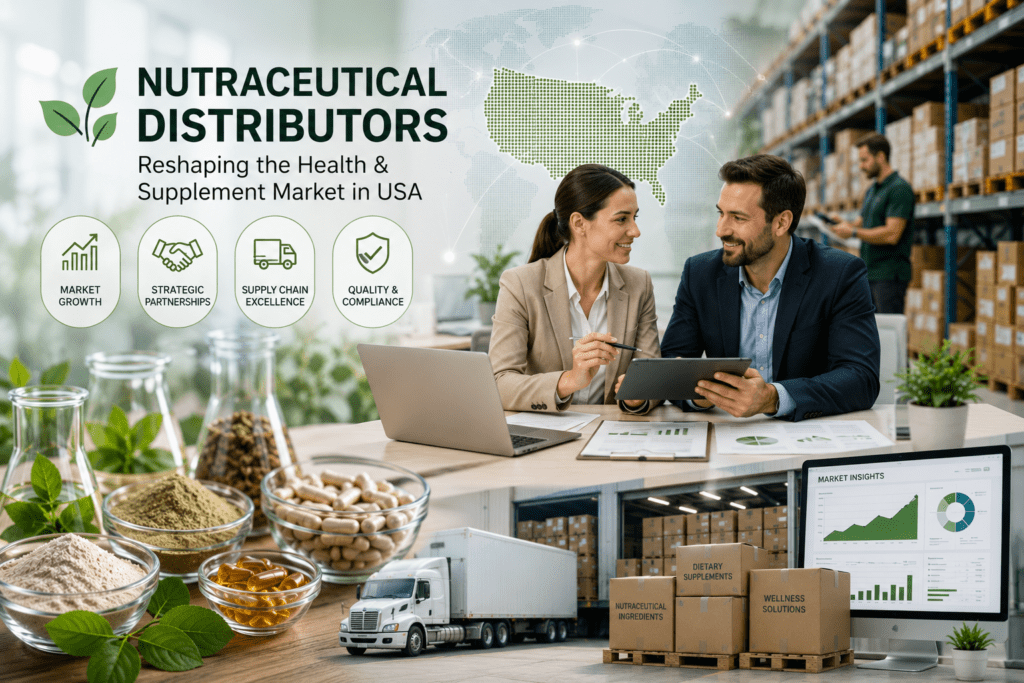
Before we go deeper, it’s worth pausing on what exactly a nutraceutical distributor in the USA actually does — because the role is far more nuanced than simply moving boxes from a warehouse to a retailer’s shelf. A nutraceutical distributor is the critical link between the manufacturer who formulates and produces health products and the end consumer who needs them. Their responsibilities include:
- supporting brands with distribution strategy
- managing supply chains across multiple regions
- ensuring regulatory compliance (including FDA guidelines)
- handling documentation and certifications
- maintaining product integrity (including cold-chain logistics where required)
How Supplement Distributors Support Business Growth
In a country as vast and complex as the United States, where federal oversight through the FDA, state-level regulations, and the demands of e-commerce platforms all intersect, a capable distributor is not a luxury — it is a necessity. A brand that produces the most scientifically advanced supplement in the world but cannot navigate the American distribution landscape will fail. Conversely, a brand backed by an experienced, compliance-oriented distribution partner can move from zero to national presence with remarkable speed. This is why the distributor relationship is the unsung engine of every successful supplement brand in America today.
The Growth of the Nutraceutical Market in the USA
The growth of nutraceuticals in the US isn’t just a trend. It’s a structural shift in how Americans relate to their own health. Driven by an aging baby boomer population seeking to maintain vitality, a generation of younger health-conscious consumers who grew up googling ingredients, and a post-pandemic world that made immune resilience a household priority, the demand for high-quality nutritional supplements has never been more sustained or more sophisticated. Functional foods and dietary supplements represent the majority share of the global nutraceutical market. Across major industry reports, tablets and capsules consistently emerge as the leading dosage form, typically accounting for roughly one-third to half of total product sales depending on market segmentation.
What’s particularly compelling is where growth is happening fastest: online. The online segment of the US nutraceutical market is projected to grow at nearly 9.8% CAGR through 2030, fueled by the rise of platforms like Amazon, direct-to-consumer brand websites, and subscription-based wellness boxes. Source: U.S. Nutraceuticals Market Report (2025–2030). This digital distribution revolution has opened the gates for international brands to enter the American market without the enormous capital expenditure traditionally required for brick-and-mortar retail penetration. It has also raised the bar for quality, transparency, and consumer trust — because on the internet, a bad review survives forever, and a great product earns its reputation review by review, customer by customer.
American Nutraceutical Supply Chain
Understanding how supplements actually reach American consumers requires a mental map of a complex, multi-layered system. It begins with raw material suppliers — often operating in India, China, or specialized agricultural regions — who extract, standardize, and certify botanical compounds, minerals, and bioactive ingredients. These raw materials flow to contract manufacturers or in-house production facilities, where they are formulated, tested, encapsulated, and packaged in temperature controlled conditions. From there, distributors take over, warehousing products, managing compliance documentation, and channeling goods through retail, wholesale, online marketplace, and direct-to-consumer pathways.
Each layer of this chain carries its own set of requirements. A botanical extract must carry a Certificate of Analysis confirming its active compound concentration. A finished supplement must meet FDA good manufacturing practice (GMP) standards. A product sold on Amazon must comply with the platform’s supplement listing policies, which have become increasingly rigorous in recent years. And through all of this, the distributor acts as the gatekeeper and guide — ensuring that a product formulated in Chennai, India, can land in the hands of a consumer in Chicago, Illinois, with full integrity intact. This is not a simple undertaking, and the brands and distributors who do it well deserve enormous credit.
Aora: Where India’s Ancient Wisdom Meets Global Science
It is against this backdrop that brands like Aora — operating under Aora India Private Limited, a Chennai-based, research-driven nutraceutical company — are writing one of the most compelling origin stories in the supplement industry. Aora is not a brand that emerged from a marketing meeting. It emerged from a deep belief that the intersection of traditional botanical knowledge and modern nutritional science could produce products genuinely worthy of the American consumer’s trust and attention.
Aora India Private Limited is a supplier, and exporter of high-quality natural extracts, specialty raw materials, serving the nutraceutical, cosmeceutical, food and beverage, and pharmaceutical industries. The company’s diversified portfolio spans standardized botanicals, natural extracts with proven antioxidant and anti-inflammatory properties, and eco-friendly, responsibly processed ingredients designed for wide-ranging functional and therapeutic applications. With strong technical expertise and robust operational resources, Aora is built for a world that demands both efficacy and ethics — clean labels, transparent sourcing, and products that actually work.
What distinguishes Aora isn’t just what they make, but why they make it. Their vision articulates a commitment to establishing a distinctive standard of excellence in delivering innovative products and value-driven services that enhance global wellness. Their mission is to enhance health — not as a marketing slogan, but as an operational mandate that shapes every sourcing, formulation, and quality control decision they make. For a brand entering the fiercely competitive American supplement market, this clarity of purpose is not just admirable; it is strategically essential.
Aora on Amazon: The Digital Distribution Playbook
Aora’s US market entry strategy is a masterclass in leveraging the world’s most powerful e-commerce platform as a launchpad. By listing products on Amazon, Aora gains immediate access to active shoppers, a built-in trust infrastructure through ratings and reviews, and a logistics network through Fulfillment by Amazon that handles the complex last-mile delivery challenges that have historically been barriers to entry for international brands.
Their flagship product currently listed in the US market, Aora Magnesium Glycinate, taps into one of the most consistently high-demand categories in the American supplement market, especially in Amazon USA. Magnesium glycinate is widely regarded as one of the most bioavailable and gastrointestinal gentle forms of magnesium, making it a preferred choice for consumers seeking to address deficiency without the digestive discomfort associated with cheaper forms like magnesium oxide. The amino acid glycine, to which the magnesium is chelated in this formulation, brings its own biochemical value — supporting muscle relaxation, sleep quality, and recovery. For athletes and older adults managing bone and cardiovascular health, this combination is not a nice-to-have. It is a cornerstone supplement.
Aora’s second US-listed product, Aora K2Vital® Vitamin K2 Supplement, is an even bolder statement of scientific credibility. The product features K2Vital® — 99.7% all-trans MK-7 form of Vitamin K2, considered the gold standard for bioactivity and stability in the Vitamin K2 category. The clinical importance of this distinction cannot be overstated. All-trans isomers are the biologically active form the human body utilizes; cis isomers, which can contaminate lower-quality K2 products, are essentially inactive. By anchoring this formulation to a patented, clinically validated ingredient, Aora signals to the American consumer and to distribution partners alike that they are not cutting corners. They are building trust through science.
The Science Behind the Supplements
Let’s spend a moment with the science, because it’s the foundation upon which distribution stories either stand or collapse. Magnesium is involved in over 300 enzymatic reactions in the human body — from energy metabolism to protein synthesis, from nerve impulse transmission to muscle contraction and relaxation. Despite its fundamental importance, research consistently suggests that a significant portion of Americans do not achieve adequate magnesium intake through diet alone. Modern agricultural practices have depleted soil magnesium content, and processed food-dominant diets compound the problem. The glycinate form, which binds magnesium to the amino acid glycine, facilitates intestinal absorption through active transport mechanisms, and because glycine itself is calming and sleep-supportive, the compound offers synergistic benefits that single-element magnesium salts cannot match.
Vitamin K2 tells an equally compelling story. While Vitamin K1 is well known for its role in blood clotting, K2 — and specifically the MK-7 form — is increasingly recognized for its critical function in calcium metabolism. It activates proteins like osteocalcin and matrix Gla-protein that direct calcium into bones and away from arterial walls. This means K2 is not just a bone health supplement; it is, in effect, a cardiovascular protector. As the American population ages and calcium supplementation becomes more widespread, the importance of pairing calcium with K2 to ensure proper routing has become a mainstream nutritional conversation. Aora’s use of K2Vital® — the patented, double-encapsulated, stability-tested form — ensures that every capsule delivers the full promise of the science behind it.
Why Join hands with Aora?
What American Consumers Are Looking For — and What Distributors Must Deliver
The American supplement consumer are highly educated. They read labels. They Google ingredients. They check third-party testing certifications. They compare prices across platforms with a single thumb swipe. They share product experiences in Reddit threads, and Amazon comment sections that carry enormous social weight. In this environment, a distributor’s ability to position a brand correctly from the outset — with the right certifications, the right claims, the right visual identity, and the right price point — is the difference between viral success and invisible failure.
Distributors operating in the US nutraceutical space must understand not just logistics, but narrative. A product like Aora’s Magnesium Glycinate is not just selling milligrams of a mineral; it is selling better sleep, faster muscle recovery, a calmer nervous system, and the peace of mind that comes from choosing a product that respects both science and the consumer’s intelligence. The story behind the product — a Chennai-based research company applying rigorous quality standards and patented ingredients to bring world-class supplementation to the American market — is itself a powerful differentiator in a sea of generic white-label products. Distributors who understand how to tell that story across digital channels, marketplace listings, and retail partnerships become invaluable strategic allies.
Key Distribution Channels in the US Nutraceutical Market
The American nutraceutical distribution landscape is multi-channel and rapidly evolving. Understanding the dominant pathways helps contextualize how brands like Aora navigate entry and scale.
E-commerce and Online Marketplaces remain the fastest-growing channel, with the online segment projected to outpace all others through 2030. Amazon, iHerb, Walmart.com, and brand-direct Shopify storefronts collectively represent the most accessible, cost-efficient route to the American consumer for an international brand. The key advantage is the absence of slotting fees and the ability to test product-market fit with minimal upfront retail commitment.
Health Food Retail channels — including national chains like Whole Foods, Sprouts, Vitamin Shoppe, and GNC, along with thousands of independent natural food stores — remain enormously influential, particularly among older, premium-spending wellness consumers. Breaking into these channels typically requires demonstrated Amazon performance as social proof, alongside compliance with each retailer’s vendor requirements, which can include specific certifications, insurance coverage, and promotional funding commitments.
Direct-to-Consumer (DTC) strategies, built around brand websites and subscription models, offer the highest margins and the richest customer data. Brands that invest in content marketing, SEO, and community building can develop deeply loyal customer bases that are insulated from Amazon algorithm changes and competitive price undercutting. For a brand like Aora, whose vision includes becoming a powerful and ethical organization that emerges as a legendary icon in e-commerce and direct selling, the DTC channel is not ancillary — it is central.
Regulatory Realities: The FDA, GMP, and What They Mean for Distributors
At a minimum, manufacturers are required to:
- Establish clear product specifications
- Test raw materials and finished products for identity, purity, strength, and composition
- Maintain comprehensive batch and quality records
- Ensure manufacturing processes consistently deliver products that meet defined standards
Brands like Aora, which operate with a research-driven, technically rigorous culture, are well positioned for this environment. Their emphasis on standardized, tested ingredients and responsible processing is precisely the organizational DNA that generates the documentation, consistency, and traceability that US distributors and regulators demand.
Supply Chain Sovereignty: The India Advantage
There is a geopolitical and economic dimension to the nutraceutical distribution story that deserves attention. India has emerged as one of the most significant suppliers of botanical extracts, standardized herbal raw materials, and specialty nutraceutical ingredients to the global market, and the US in particular. India’s advantages are multiple and compounding: a rich biodiversity of medicinal plants, a centuries-deep tradition of herbal medicine that provides a foundation for botanical expertise, a large and growing pool of pharmaceutical and nutraceutical manufacturing talent, and increasingly sophisticated quality infrastructure aligned with global GMP standards.
For a Chennai-based company like Aora India Private Limited, these advantages are not merely theoretical. They are embedded in the company’s operational reality — in the relationships with botanical suppliers, in the quality control systems, in the research capabilities that allow Aora to work with natural extracts with proven antioxidant and anti-inflammatory properties and eco-friendly, responsibly processed ingredients. This supply chain proximity to primary botanical sources, combined with a commitment to modern scientific standards, creates a value proposition that pure domestic US manufacturers often struggle to match on both quality and cost dimensions. Distributors who understand this India advantage are increasingly seeking out Indian nutraceutical manufacturers as strategic supply chain partners.
Building Brand Trust in the American Market: Lessons from the Shelf
Trust is the currency of the supplement industry, and it is earned slowly and lost instantly.
What does transparency look like in practice? It looks like third-party testing certifications displayed prominently on product pages. It looks like QR codes linking to Certificates of Analysis. It looks like honest, science-backed claims that don’t promise miracles but do accurately communicate genuine benefits. It looks like responsive customer service, real reviews, and the kind of product consistency that turns a first-time buyer into a subscription customer. For Aora, whose vision is built on a distinctive standard of excellence and whose mission is fundamentally about enhancing health rather than extracting revenue, this approach to trust-building is not a strategy adopted for the American market — it is the company’s native operating philosophy.
The Future of Nutraceutical Distribution: Where It’s All Heading
As we look toward the second half of this decade, several forces are reshaping what nutraceutical distribution looks like in America — and creating openings for forward-thinking brands like Aora to establish durable competitive positions.
Personalized nutrition is moving from niche to mainstream. Consumers increasingly want supplements tailored to their specific biology, lifestyle, and health goals, driven by genetic testing, blood biomarker analysis, and AI-powered recommendation engines. Distributors who build partnerships with personalized nutrition platforms gain access to data-driven demand signals that generic distribution arrangements simply cannot provide.
Sustainability and clean-label demand are intensifying. Consumers — especially younger demographics — are scrutinizing not just what is in a supplement but how it was made, what it is packaged in, and whether the sourcing practices behind it are ethically defensible. Aora’s commitment to eco-friendly, responsibly processed ingredients is not just good ethics; it is increasingly good business in the American market.
Brands that diversify their distribution channels early — rather than depending entirely on any single platform — build resilience against algorithm changes, fee increases, and policy shifts that have upended more than a few single-channel supplement businesses.
Why Brands Like Aora Represent the Next Chapter
The story of nutraceutical distribution in the United States is ultimately a story about trust, science, and the global flow of wellness knowledge. It is a story about what happens when a company rooted in one of the world’s great botanical traditions — India’s — applies rigorous modern science to that tradition and brings the result to a market of consumers hungry for exactly what that combination produces.
When a customer in Seattle clicks “Add to Cart” on Aora’s Magnesium Glycinate, they are not just buying a supplement. They are participating in a chain of decisions and commitments that stretches from a research lab in Chennai to a quality-controlled production floor, through compliance documentation and Amazon’s fulfillment infrastructure, to their own nightstand, where the capsule will help them sleep better, recover faster, and function at a higher level the next day. When a consumer in Atlanta orders Aora’s K2Vital® Vitamin K2, they are trusting that the patented ingredient inside that capsule will actually direct calcium to their bones and away from their arteries — that the science is real and the product delivers what it promises.
That trust is built, not bought. It is built through research rigor, manufacturing discipline, transparent labeling, quality ingredients, and the kind of organizational mission that sees health enhancement not as a product category but as a genuine human purpose. It is built by distributors who care about the brands they represent, not just the margins they generate. And it is built by consumers who have decided, like Marcus in Austin, that investing in their health is among the wisest decisions they can make.
Conclusion: The Opportunity Is Now
The American nutraceutical distribution landscape has never been more open to quality, science-backed international brands than it is right now. The infrastructure exists. The consumer demand is real, growing, and sophisticated. The regulatory environment, while demanding, is navigable for companies that take compliance seriously from day one. And the digital distribution channels — Amazon chief among them — provide a direct line from manufacturer to consumer that bypasses the gatekeeping costs of traditional retail entry.
For Aora, the opportunity is not merely commercial. It is an expression of a vision — to positively impact humanity, to build an organization that stands for something, to bring to American consumers the best of what global botanical science and modern nutraceutical research can produce together. As the US market for supplements continues its robust growth trajectory, brands that combine Chennai’s research depth with the American market’s demand for transparency and quality will not just participate in that growth. They will help define it. Join hands with us and source best products from us at reasonable price.
Aora products are available on Amazon US. Explore Aora’s Magnesium Glycinate and Aora Patented K2Vital® Vitamin K2 Supplement to experience the standard of quality that drives the company’s global mission.